

Divine Discontent
The Wind in the Willows and the promise of spring

“Bother! Hang spring-cleaning!” declares Mole, and from there the adventures begin. He casts aside his brooms and dusters and ladders and whitewash and scrabbles up his tunnel to the warm world outside, where the sunshine strikes his fur and the breezes caress his brow. He rambles through the meadows and meanders along to a river—The River, a gurgling, laughing, glinting river, the first he has seen before.
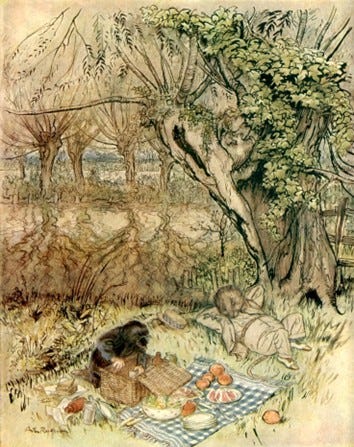
There he meets Rat, and there he enters his first boat, and there they mess about on the water and row ashore for a picnic and talk of Mr. Badger and become fast friends. By chapter 2, now summertime, Mole and Rat are off on trips and visits involving Mr. Toad and Mr. Badger and beginning their true adventures.
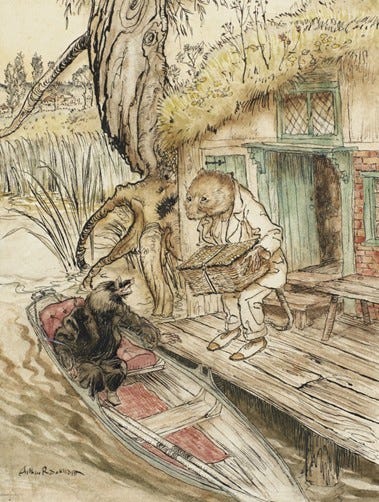
The Wind in the Willows takes us through all four seasons, but it begins in spring, and in my mind it will always be a spring story. Mole and Rat owe all their subsequent exploits to springtime, that shimmery sliver of the seasons that beckons and calls to us with something bordering on the beatific. Mole was dutifully cleaning when spring spoke to him and lured him outside.
Spring was moving in the air above and in the earth below and around him, penetrating even his dark and lowly little house with its spirit of divine discontent and longing.
“Divine discontent and longing.” I wonder if C.S. Lewis ever recalled this scene when he was writing Surprised by Joy and talking about sehnsucht. It’s a fitting description of sehnsucht, joy so piercing as to be painful, pain so beautiful as to become joy. Lewis’s life was marked by these episodes, from childhood on. Eventually in adulthood these stabs of not-quite-fulfilled beauty accumulated to fill the hollow of his atheism and demonstrate the truth of the Gospel.
Spring offers an especially powerful type of sehnsucht, I think, because we get a foretaste of a yet-unfulfilled promise: that one day all things will be made new. For now, at least, it seems all things really are made new, and we only wish they would last.
Lewis himself made that connection in verse:
What the Bird Said Early in the Year
I heard in Addison’s Walk a bird sing clear:
This year the summer will come true. This year. This year.
This year time’s nature will no more defeat you.
Nor all the promised moments in their passing cheat you.
This time they will not lead you round and back
To Autumn, one year older, by the well worn track.
Each year brings a new promise of fulfillment, the enthralling prospect that as surely as spring buds give way to the fruit of summer, so summer “will come true” – will come to fruition that lasts this time. But then summer leads back around to Autumn, like a “well worn track,” and we start the cycle anew.
Yet the promise isn’t futile, and Lewis tells us this too. The place Lewis set his poem, Addison’s Walk, is the scene of his first steps toward Christianity – the springtime of his conversion, if you will. He traversed Addison’s Walk until midnight one night, walking with J.R.R. Tolkien and Hugo Dyson, discussing whether Christianity might be the one true myth, the true story all the ancient tales anticipated, the ultimate dying and rising foretold in the seasons themselves. Though the earth has not yet been made new, in Christ we can be made new, and this already-but-not-yet conundrum speaks of the juxtaposition of springtime’s promise and its impermanence.
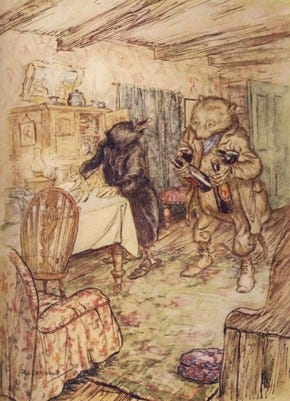
Mole and Rat don’t get all the way to the Gospel in The Wind in the Willows, though they do stumble into Pan, a kind of beast-god, a deity incarnate for a world of animals. Still, it’s no surprise that The Wind in the Willows was one of Lewis’s favorites. He remarked in his essay “On Three Ways of Writing for Children,” that “I never met The Wind in the Willows…’till I was in my late twenties, and I do not think I have enjoyed [it] any the less on that account.”
Part of Lewis’s love for Kenneth Grahame’s story is surely the prevalence of “dressed animals.” Lewis loved animals that behave as humans, and his early fiction writing as a child involved his make-believe world of Boxen inhabited by busy animals who of course wear clothes.
Part is due to Grahame’s creative juxtaposition of “the sort of freedom we can have only in childhood and the sort we can have only in maturity,” as Lewis wrote of The Wind in the Willows in “On Three Ways of Writing for Children.” Rat and Mole have the carefree spirit of children but the privileges of adulthood, and they inhabit a world that seems almost ageless. There are some children, and Mr. Badger seems clearly a senior figure, but the world of The Wind in the Willows is a bit like Aslan’s Country in The Last Battle: As Lucy, Edmund, and the rest go “further up and further in,” swimming up waterfalls and playing like children, Professor Kirk and Tirian and all the older generation seem to become younger until everyone has almost no age at all. Might it be a permanent springtime they’re suspended in?
But the “divine discontent” of spring must be a major source of Lewis’s enjoyment of The Wind in the Willows.
It certainly is for me.
More spring stories
Picture books can capture glimmers of this divine discontent, perhaps leaning more towards the joy than the pain of sehnsucht. Here are a few favorites for the season. (Our March list had some spring books, too.) I may earn a small commission on purchases through my affiliate links below.
Brambly Hedge: Spring Story, by Jill Barklem
Brambly Hedge offers art reminiscent of Beatrix Potter, storylines that evoke scenes from The Wind in the Willows, and characters that, were they not mice, would make very nice hobbits.
This is a town of industrious but jolly garden-loving mice who delight in merry-making. Their vigor for play is impressive. They love good food and drink and yearn for the outdoor world.
Like Rat and Mole, these are carefree but mature animals. They go where they please, eat what they want, drop in on each other for spontaneous visits, lollygag by the stream, and still manage to have entire Store Stumps filled with delicious dishes. I wish my larder could mimic Brambly Hedge’s.
In this story, young Wilfred has a birthday and the whole town gathers for a spontaneous picnic. All the adults must have, at some previous time, carefully worked and saved and stored up food, but now they cast aside their work for vigorous play, leading up to a pleasant surprise for Wilfred at the end.
C.S. Lewis would love the abundance of “dressed animals.”
Flower Fairies of the Spring, by Cicely Mary Barker
Cicely Mary Barker invites us to see the magic of the natural world, and her whole series is a delight, though this springtime collection is my favorite of her books. Barker presents 20 flowers reimagined as fairies in both a poem and a painting.
The poems glimpse some characteristic feature of each flower. The dandelion is stubborn. The daisy is playful. Then the art presents to us each fairy clothed in his or her respective flower. One of the chief delights in this book is the imaginative romp through anthropomorphized nature as we see petals and sepals and seeds and leaves turned into clothes for each fairy to wear.
The art and the words are delights in themselves, but for they offer many practical values, too. What better way to learn your flowers and trees? (Please, some fellow Arizonan, write something in this vein for the desert.) And each poem is short, making an especially delightful choice for memorization.
Make Way for Ducklings, by Robert McCloskey
Mr. and Mrs. Mallard have searched far and wide for a nesting site, and nothing quite suits Mrs. Mallard’s fancy. Eventually they find a suitable spot along the Charles River where Mrs. Mallard can lay her eggs, and when Mr. Mallard goes on a trip, Mrs. Mallard arranges to meet him in the Public Garden, all eight ducklings in tow.
The only problem is that the Garden is in the middle of Boston, and Mrs. Mallard will need some help to get her carefully trained line of ducklings across traffic.
It’s a beautiful story of family, a tribute to the city of Boston, and, though Robert McCloskey probably didn’t imagine this application, a little encouragement for moms in the early years of parenting. Mrs. Mallard raises eight ducklings and dares to take them all out in public on her own. Impressive!
Winner of the Caldecott, the official children’s book of the state of Massachusetts, this classic is probably already on your shelf.
But did you know that Robert McCloskey found it necessary to live with ducks in order to draw Mr. and Mrs. Mallard? Mr. McCloskey’s Marvelous Mallards tells the lively story behind the book, and the great lengths to which McCloskey went in order to get his illustrations right. As a bit of author lore it’s fun, and it’s also a timely reminder that good things are hard to do.
Cactus Hotel by Brenda Guiberson, illustrated by Megan Lloyd
I live in Arizona, and I’ve got to include one book that more accurately shows what springtime looks like here. Even if you do not live where saguaro thrive, you, too, can appreciate this life-story of the saguaro cactus.
A saguaro grows incredibly slowly, not growing its first arm until about 70 years old, and often living for 200 years. So don’t fear if you, like the saguaro, have many decades under your belt but haven’t begun all you hope to accomplish.
The saguaro relies on a nurse plant to thrive and in its lifetime, it in turn becomes home for innumerable creatures. Even if you don’t live in Arizona, this is a well-illustrated, fascinating nature study.
The Wind Blew, by Pat Hutchins
The wind blows everything, one item at a time, one page at a time, until a coterie of the wind-robbed chase their lost belongings, all to great humor. The rhymes and short sentences per page make this a top choice for young kids just graduating out of board books.
Mossy, by Jan Brett
An Eastern box turtle carries a garden swaying atop her carapace, attracting the attention of both a handsome male turtle and a scientist who wants Mossy for her museum. Jan Brett’s illustrations are, as always, intricate and lovely, with lots of good models for your own nature drawing.
What are you reading in April?
And what books give you a sense of the “divine discontent” of spring?
Ordered Flower Fairies of the Spring! I've been wanting to get Charlotte more into fairies because they're my favorite mythical creature (their absence being the one thing that puts a damper on Narnia for me 😅). Glad to have this recommendation!
Wind in the Willows, C.S. Lewis, and springtime is about as wonderful as trio as I've found on Substack. This is lovely.